

Frameless and semi-frameless glass pool fencing can produce quite different results around the same swimming pool.
The distinction is easy to see: a semi-frameless system introduces upright supports between sections of glass, while a frameless system does not use those regular vertical supports between the main panels.
But that alone does not tell you which one will suit your property.
A better approach is to look at the actual fence line, where the gate will sit, how many times the fence changes direction and what already occupies the backyard.

Start by Mapping the Whole Fence Line
Before concentrating on individual panels, picture the complete run of pool fencing.
A simple fence extending along two or three straight sides will read differently from one that has several short sections, corners and returns.
This matters when comparing the two systems because every change along the fence adds another visual element.
With semi-frameless fencing, the position of the upright supports becomes part of that pattern. With frameless glass pool fencing, the divisions between the glass panels are less pronounced.
For that reason, the same fencing choice can have a very different effect on two Melbourne properties.
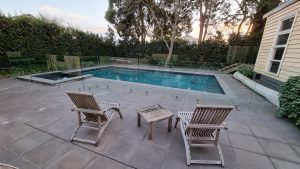
Work Backwards From the Pool Gate
The gate is one of the most noticeable parts of any pool fence, so its position deserves attention early in the planning process.
Consider where people naturally approach the pool. Is access from the house, an alfresco area, a side path or another part of the garden?
Once the gate position is established, look at how the remaining fencing extends away from it.
On some layouts, a frameless system can keep this area visually simple. On others, the upright elements of semi-frameless fencing can sit comfortably alongside the gate and create a deliberate sequence around the pool.
Planning from the entry point can be more useful than choosing a fencing style first and trying to make the layout fit afterwards.
Pay Attention to Corners and Short Sections
Long stretches of fencing tend to receive most of the attention in photographs, but many residential pools contain shorter sections that can have a big influence on the finished result.
Look closely at:
- corners around the pool
- narrow areas beside the house
- small returns near landscaping
- short sections beside a gate
- changes in the direction of the fence
These areas can introduce several components within a relatively small space.
For a compact pool area, frameless glass pool fencing may reduce the number of features competing for attention. Where there is more room around the pool, the additional definition of a semi-frameless system may not feel as prominent.
Use Your House as the Reference Point
Instead of asking whether frameless or semi-frameless fencing looks better generally, compare each option with the property itself.
Look at the lines already present on the exterior of the home.
A house may have prominent window frames, pergola supports, screening, fencing or other repeated elements. In that setting, semi-frameless pool fencing can introduce another structured detail without appearing out of place.
A property with fewer exterior features may lead you towards a different choice.
The objective is not necessarily to match the house. It is to avoid introducing a fence that feels unrelated to everything around it.
Consider Where Landscaping Meets the Fence
Plants and garden beds can also change the way glass pool fencing is perceived.
A section positioned against dense planting has a different backdrop from one running across paving or an open lawn.
If much of the fence will eventually sit alongside established landscaping, the visual difference between frameless and semi-frameless may become less significant in those areas.
Where the fence crosses an open section of the backyard, the distinction between the two systems can become more noticeable.
Including existing and planned landscaping in the decision can therefore give you a more realistic idea of the finished pool area.
Don’t Forget the View at Night
Pool fencing is not only seen during the day.
Outdoor lighting, illuminated pools, and lights from inside the house can change how glass and hardware appear after dark.
If you frequently use the backyard in the evening, consider where lighting is positioned in relation to the proposed fence.
Reflections on glass, illuminated fittings and shadows from surrounding structures can all alter how prominent the fence appears.
It is a small detail, but one that is easily overlooked when comparing fencing from daytime photographs.
A Simple Way to Narrow Down the Choice
If you are still deciding between the two systems, ask three questions:
- Is the proposed fence line simple or made up of many shorter sections?
- Do existing features around the house already create strong vertical lines?
- Do you want the fence itself to be a noticeable part of the backyard layout?
Your answers will usually make one option more suitable than the other.
Frameless glass pool fencing can work well where reducing visual detail around the fence line is important.
Semi-frameless glass pool fencing can suit properties where the additional upright elements work comfortably with the broader layout of the home and garden.
Compare the Options at Your Property
Choosing pool fencing from a photograph only shows you how it worked on somebody else’s property.
Melbourne Glass Pool Fencing can assess your proposed fence line and help you compare how frameless and semi-frameless options could work around your own pool.
Planning glass pool fencing in Melbourne? Contact Melbourne Glass Pool Fencing on (03) 9898 9600 to discuss your project and arrange a free quote.
Recent Posts
- Can Glass Pool Fencing Be Installed on Decking, Pavers, Concrete or Sloping Ground?
- Glass Pool Fence Installation: What Happens From Measure & Quote to Installation?
- Frameless vs Semi-Frameless Glass Pool Fencing: Which Is Right for Your Melbourne Home?
- How to Choose the Right Pool Fence Installer in Melbourne
- Designing a Seamless Pool Fence: Integrating Glass Pool Fencing with Outdoor Living Spaces in Melbourne